Walk into a quiet garage on a Saturday morning. The air hangs heavy with the familiar scent of cured rubber and the faint, metallic tang of cooling exhaust. Your Toyota Tacoma rests there, ticking softly as the metal contracts after a long week of commuting.
You probably spent yesterday afternoon pouring expensive synthetic fluid into its crankcase, feeling the quiet satisfaction of doing things right. We are taught that a truck’s lifespan depends entirely on the brand of liquid gold you feed it. You picture pristine metal moving smoothly, assuming the oil alone wards off the ghosts of engine failure.
But professional mechanics view a high-mileage engine differently. They see a living, breathing system of pressures and vacuums. While you obsess over oil viscosity, the true threat to your engine’s future isn’t friction. It is trapped breath. The difference between a block that reaches 300,000 miles and one that blows a rear main seal at 120,000 often comes down to a piece of plastic and metal no larger than a thumb.
This tiny component sits quietly near the valve cover, vibrating with every stroke of the pistons. It costs less than a fast-food breakfast, yet it dictates whether your oil seals hold strong or burst under silent, suffocating pressure. Overlooking this tiny factory piece changes the entire trajectory of your truck’s life.
The Anatomy of Trapped Breath
Think of your engine block as a set of lungs working inside a sealed glass box. Every time a spark plug fires, tiny amounts of explosive gas slip past the piston rings. This is normal. But if those gases have nowhere to go, they build a creeping, invisible wall of pressure inside the crankcase.
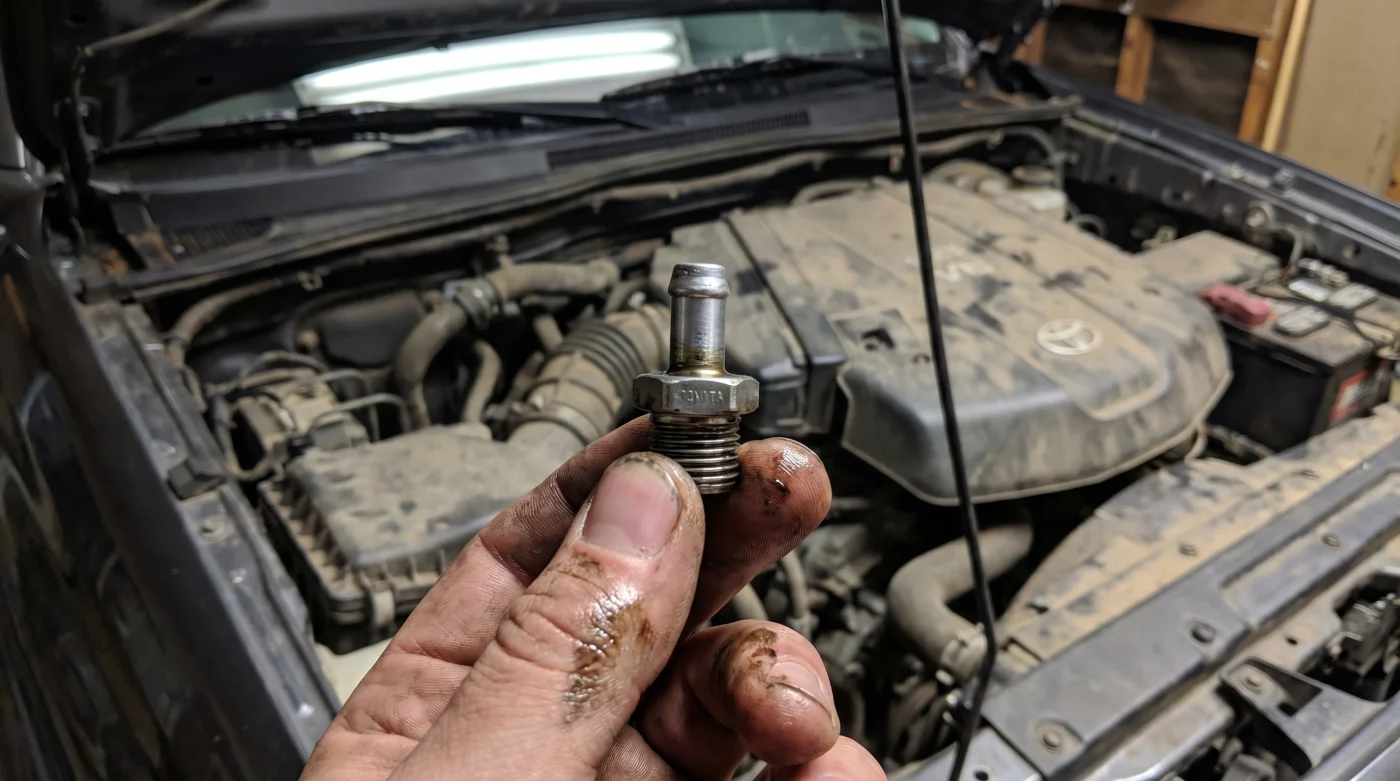
This is where the PCV valve steps in. It acts as a mechanical exhale, pulling those toxic, pressurized fumes out of the crankcase and feeding them back into the intake to be burned. When it gets clogged with carbon and sludge, your engine is suddenly breathing through a pillow. The pressure mounts, searching desperately for an exit.
And it always finds one. Instead of escaping safely through the valve, the pressure forces its way out through your weakest engine gaskets. Suddenly, you have a weeping oil pan or a ruptured rear main seal. A repair that should have cost five dollars and taken two minutes now requires pulling the entire transmission to fix.
Consider Mark Vance, a 58-year-old master technician who has spent three decades tearing down Toyota blocks in rural Pennsylvania. He keeps a coffee can on his workbench filled entirely with seized, sludged-up PCV valves. He pulls one out, rattling it near his ear to demonstrate the dead silence of a stuck internal spring. “People bring me these Tacomas with blown gaskets, swearing they changed the oil every three thousand miles,” he notes. “They did everything right, except they never let the engine exhale.”
Tailoring Your Maintenance Routine
Not every truck ages at the same pace. Your driving habits directly alter how quickly this tiny valve fills with soot and moisture.
If your daily routine involves long stretches of steady highway speeds, your engine runs hot enough to burn off internal moisture. Your valve stays cleaner longer. You can comfortably push this replacement to the standard 30,000-mile mark without courting unexpected gasket failures.
Running errands around town means the engine rarely reaches its optimal operating temperature. Condensation mixes with oil vapor to create a thick, milky sludge that chokes the PCV valve rapidly. If your trips are mostly under five miles, treat this as a 15,000-mile replacement.
Towing heavy trailers or crawling over mountain passes increases internal cylinder pressure. More blow-by gas forces its way into the crankcase, carrying heavy carbon deposits. In this environment, swapping the valve annually becomes cheap insurance against a catastrophic seal blowout on the highway.
The Five-Minute Exhale
Replacing this component requires no specialized skill. It asks only for a few minutes of quiet attention under the hood. Wait for the engine to cool completely so the metal is safe to touch without burning your forearms.
Pop the hood and locate the valve cover. You are looking for a thick black rubber hose routing toward the top of the engine block. At the end of that hose, plugged directly into the metal, sits the valve. Pinch the retaining clip and gently slide the hose free.
Here is your tactical toolkit:
- One OEM Toyota PCV Valve (insist on factory metal, avoiding cheap aftermarket plastics).
- A pair of needle-nose pliers to release the hose clamp.
- A 19mm deep socket or an adjustable wrench.
- Five minutes of patience.
Unscrew the old valve counterclockwise. When you pull it free, give it a shake. If it sounds like a solid piece of plastic or barely clicks, it was already failing. Thread the new one in by hand first to avoid crossing delicate aluminum threads, then snug it down gently with your wrench. Slide the hose back on.
More Than Just Metal and Oil
Understanding the actual mechanics of your daily driver shifts your relationship with the machine. You move from being a passive consumer of maintenance schedules to an active steward of your vehicle’s physical health.
There is a profound peace of mind in knowing the exact state of your engine’s breathing. When you swap out a five-dollar part yourself, you aren’t just saving a trip to the dealership. You are reclaiming control over your mobility, ensuring that your truck remains a reliable partner for decades.
The next time you twist the key and hear that familiar rumble, you won’t just think about the expensive oil coating the pistons. You will hear a system running in perfect balance, exhaling freely, ready to conquer the next hundred thousand miles without breaking a sweat.
An engine does not die from old age; it suffocates from neglected routines.
| Key Point | Detail | Added Value for the Reader |
|---|---|---|
| PCV Valve Function | Vents explosive crankcase gases back into the intake. | Prevents invisible pressure from destroying oil seals. |
| Replacement Interval | Every 15k to 30k miles depending on driving habits. | Provides a customizable maintenance timeline for your lifestyle. |
| OEM vs Aftermarket | Factory metal valves have reliable spring tension. | Guarantees long-term safety without risking brittle plastic breaks. |
Frequently Asked Questions
Is it really necessary to buy an OEM valve? Absolutely. Cheap aftermarket valves often use inferior springs that stick open or closed under high heat, defeating the purpose entirely.
How do I know if my PCV valve is currently failing? You might notice rough idling, unexpected oil consumption, or a weeping seal around your valve cover. If you pull the valve and it doesn’t rattle when shaken, it is dead.
Can I just clean the old valve instead of replacing it? While you can spray brake cleaner through it, the internal spring loses tension over time. For five dollars, it is always safer to replace the mechanical part entirely.
Will this fix an oil leak that has already started? It will stop the pressure that caused the leak, but it won’t repair a torn gasket. However, replacing the valve often stops minor seepage from getting worse.
Does this apply to all Tacoma engine sizes? Yes. Whether you have the 2.7L four-cylinder or the 4.0L V6, crankcase pressure is a universal reality that must be managed on every model.